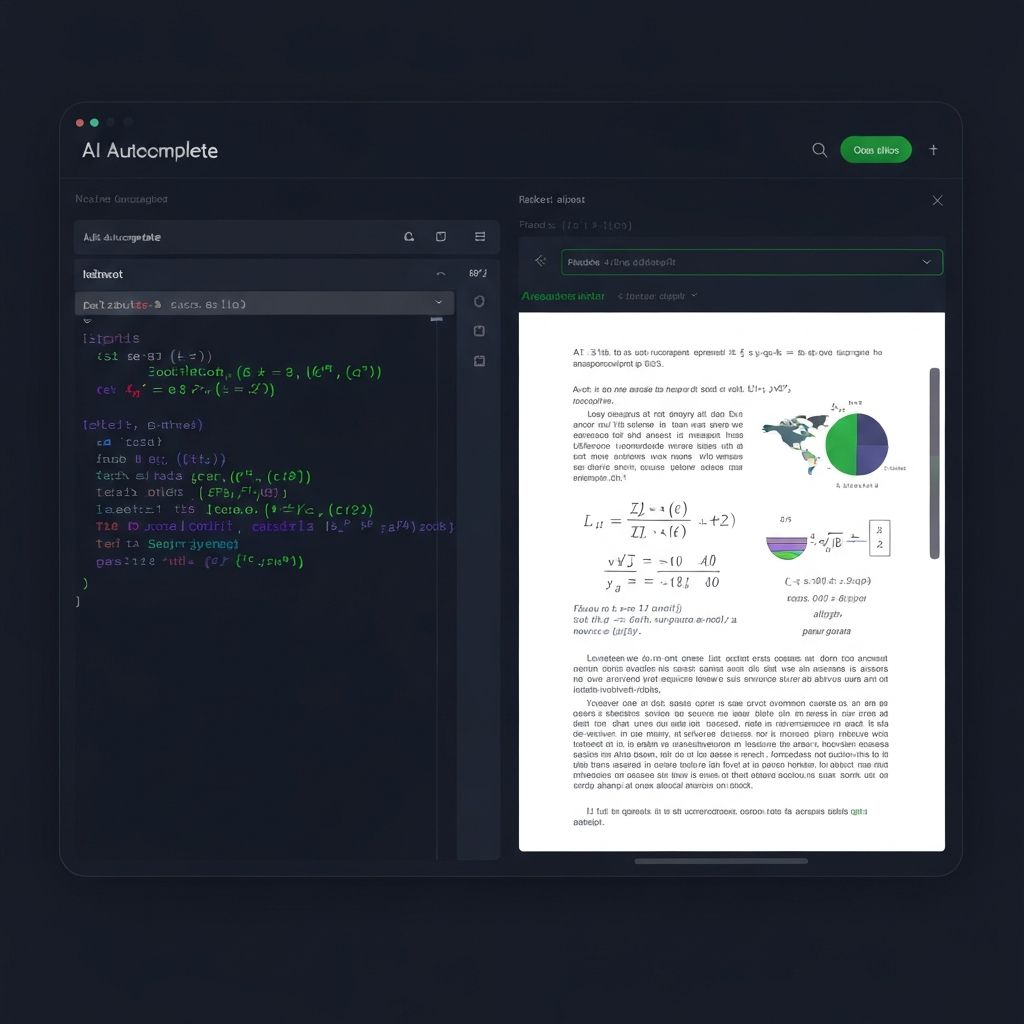
The average research paper takes between 40 and 80 hours to write. A significant portion of that time is not spent on research — it is spent fighting your tools. Reformatting references. Fixing equation syntax. Adjusting margins for the third time because a journal changed their template. AI LaTeX editors eliminate most of this friction. Here is how to use them properly.
The Biggest Time Drains in Academic Writing (and How AI Fixes Them)
1. Citations and Bibliography (Saves ~4 hours per paper)
Manual BibTeX entry is one of the most tedious parts of LaTeX writing. A typical 30-citation paper means 30 entries, each requiring title, authors, year, journal, volume, pages, and DOI — all formatted exactly right. One typo breaks compilation. Bibby AI's citation intelligence eliminates this entirely: paste a DOI or arXiv ID and it populates a perfect BibTeX entry automatically. It also detects duplicate citations and flags papers that are not yet in your bibliography when you reference them.
2. Equation Writing (Saves ~3 hours per paper)
Writing complex LaTeX equations from scratch is error-prone and slow. Bibby AI's equation autocomplete understands mathematical context — start typing \int_{} and it suggests the most likely integral form based on the surrounding content. For physics papers, it recognizes Dirac notation, tensor indices, and operator conventions. For statistics papers, it handles expectation operators, probability distributions, and summation notation correctly.
3. Journal Formatting (Saves ~3 hours per submission)
Every journal has different formatting requirements. IEEE uses two-column, 10pt, specific margin specs. Nature requires single-column with line numbers. Physical Review has its own template system. Manually reformatting between these — especially late in the submission process — is painful. Bibby AI's one-click journal formatting handles all of this. Select your target journal from 500+ templates and the editor reformats your entire document instantly, including figure placement, bibliography style, and header formatting.
The Optimal AI-Assisted Research Paper Workflow
- 1Start in Bibby AI with an outline — use the AI to expand each section heading into a paragraph structure
- 2Write your methods and results sections first (most concrete, least likely to change)
- 3Use equation autocomplete throughout — never type a full equation from scratch
- 4Import your bibliography via DOI/arXiv as you write, not as a separate step at the end
- 5Use the grammar AI pass on each completed section to catch passive voice and unclear phrasing
- 6When ready to submit, select your target journal template — Bibby AI reformats everything in seconds
- 7Export directly to PDF for submission, or use the arXiv direct submission integration
Researchers who follow this workflow report completing papers in 35-45 hours on average — down from 60-80 hours using traditional tools. The biggest gains come from citation automation and journal formatting.
Why Overleaf Cannot Compete With This Workflow
Overleaf users reading this will notice that several of these steps are impossible or manual in their current tool. Citation intelligence does not exist in Overleaf — you copy-paste BibTeX entries from Google Scholar. Equation autocomplete is not available. Journal formatting is a manual template-swap process. Overleaf was built before AI, and it shows.
The productivity gap between Bibby AI and Overleaf is not marginal — it is structural. Overleaf can improve its UI, but it cannot make up for the absence of AI without a ground-up rebuild. Meanwhile Bibby AI costs $7 less per month. The decision should be straightforward for any researcher who values their time.
Getting Started
Bibby AI offers a full free trial at trybibby.com. You can import an existing Overleaf project directly — the import tool handles all package dependencies and bibliography files automatically. Most researchers are fully migrated and productive within 20 minutes of their first login.